Vorhofflimmern Kompakt

Vorhofflimmern ist eine häufige Herzrhythmusstörung, bei der die elektrische Aktivität des Herzens unregelmäßig wird. Dies kann zu Symptomen wie Herzrasen, Müdigkeit, Atemnot und Schwindel führen.

Vorhofflimmern

Ursachen und Risikofaktoren

  • Alter: Das Risiko steigt mit zunehmendem Alter.
  • Herzkrankheiten: Herzinfarkt, Herzklappenprobleme und andere Herzkrankheiten können Vorhofflimmern verursachen.
  • Hypertonie: Ein unkontrollierter Bluthochdruck kann das Risiko erhöhen.
  • Alkohol: Übermäßiger Alkoholkonsum kann zu Vorhofflimmern führen.
  • Andere Faktoren: Diabetes, Schilddrüsenerkrankungen und Schlafapnoe können ebenfalls das Risiko erhöhen.

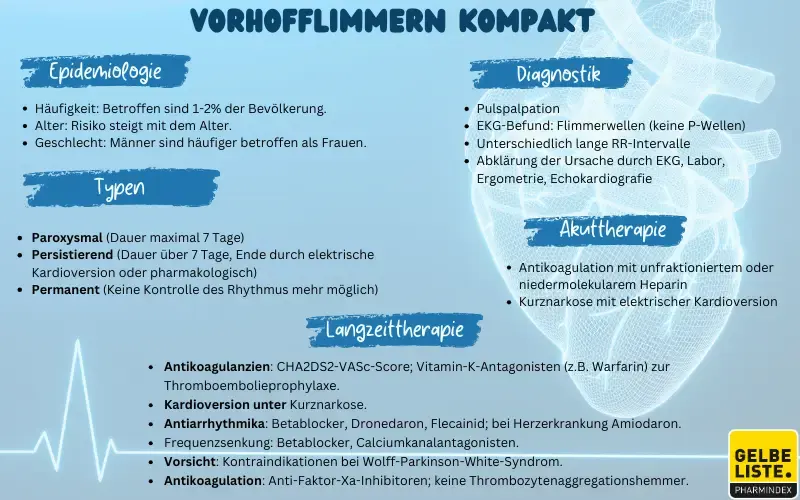
Typen

  • Paroxysmal (Dauer maximal 7 Tage)
  • Persistierend (Dauer über 7 Tage, Ende durch elektrische Kardioversion oder pharmakologisch)
  • Permanent (Keine Kontrolle des Rhythmus mehr möglich)

Diagnostik

  • Pulspalpation
  • EKG-Befund: Flimmerwellen (keine P-Wellen)
  • Unterschiedlich lange RR-Intervalle
  • Abklärung der Ursache durch EKG, Labor, Ergometrie, Echokardiografie

Behandlung

Akuttherapie:

  • Antikoagulation mit unfraktioniertem oder niedermolekularem Heparin
  • Kurznarkose mit elektrischer Kardioversion

Langzeittherapie:

Vor jeder Kardioversion müssen Ursachen, die therapierbar sind wie beispielsweise eine vorliegende Hyperthyreose behandelt werden. Darüber hinaus muss ein Vorhofthrombus ausgeschlossen werden.

Vorbeugung

Ein gesunder Lebensstil kann helfen, das Risiko von Vorhofflimmern zu reduzieren. Dazu gehören eine ausgewogene Ernährung, regelmäßige Bewegung, Vermeidung von übermäßigem Alkoholkonsum und Kontrolle von Bluthochdruck und Diabetes.


Hier geht's zum Langtext Vorhofflimmern

Autor:
Stand:
21.09.2023
Quelle:
  1. Hindricks, G. et al. (2021): 2020 ESC Guidelines for the diagnosis and management of atrial fibrillation developed in collaboration with the European Association for Cardio-Thoracic Surgery (EACTS): The Task Force for the diagnosis and management of atrial fibrillation of the European Society of Cardiology (ESC) Developed with the special contribution of the European Heart Rhythm Association (EHRA) of the ESC. European Heart Journal, DOI: 10.1093/eurheartj/ehaa612.
  2. Brundel, B. J. J. M. et al. (2016): Atrial fibrillation. Nature Reviews Disease Primers, DOI: 10.1038/s41572-022-00347-9.
  3. Staerk, L. et al. (2017): Atrial Fibrillation: Epidemiology, Pathophysiology, and Clinical Outcomes. Circulation Research, DOI: 10.1161/CIRCRESAHA.117.309732.
  4. Morin, D. P. et al. (2016): The State of the Art: Atrial Fibrillation Epidemiology, Prevention, and Treatment. Mayo Clinic Proceedings, DOI: 10.1016/j.mayocp.2016.08.022.
  5. Schnabel, R. B. et al. (2012): Atrial Fibrillation: Its Prevalence and Risk Factor Profile in the German General Population. Deutsches Ärzteblatt International, DOI: 10.3238/arztebl.2012.0293.
  6. Lubitz, S. A. et al. (2010): Association between familial atrial fibrillation and risk of new-onset atrial fibrillation. JAMA, DOI: 10.1001/jama.2010.1690.
  7. Zabel, M. (2014): Vorhofflimmern. In: Lehnert, H. et al. (Hrsg.): DGIM Innere Medizin. Springer Reference Medizin. Springer, Berlin, Heidelberg, DOI: 10.1007/978-3-642-54676-1_488-1.
  8. Waldmann, V., Khairy, P. (2021): Pathophysiology, Risk Factors, and Management of Atrial Fibrillation in Adult Congenital Heart Disease. Cardiac Electrophysiology Clinics, DOI: 10.1016/j.ccep.2020.10.007.
  9. Teuwen, C. P., de Groot, N. M. S. (2017): Atrial Fibrillation: The Next Epidemic for Patients With Congenital Heart Disease. Journal of the American College of Cardiology, DOI: 10.1016/j.jacc.2017.08.080.
  10. Teuwen, C. P. et al. (2018): Frequent atrial extrasystolic beats predict atrial fibrillation in patients with congenital heart defects. Europace, DOI: 10.1093/europace/euw300.
  11. Kim, J. A. et al. (2021): Genetics of Atrial Fibrillation. Current Opinion in Cardiology, DOI: 10.1097/HCO.0000000000000840.
  12. Chen, Y. H. et al. (2003): KCNQ1 gain-of-function mutation in familial atrial fibrillation. Science, DOI: 10.1126/science.1077771.
  13. Roselli, C. et al. (2018): Multi-ethnic genome-wide association study for atrial fibrillation. Nature Genetics, DOI: 10.1038/s41588-018-0133-9.
  14. Haïssaguerre, M. et al. (1998): Spontaneous Initiation of Atrial Fibrillation by Ectopic Beats Originating in the Pulmonary Veins. New England Journal of Medicine, DOI: 10.1056/NEJM199809033391003.
  15. Yao, C. et al. (2018): Enhanced Cardiomyocyte NLRP3 Inflammasome Signaling Promotes Atrial Fibrillation. Circulation, DOI: 10.1161/CIRCULATIONAHA.118.035202.
  16. Li, N., Brundel, B. (2020): Inflammasomes and Proteostasis Novel Molecular Mechanisms Associated With Atrial Fibrillation. Circulation Research, DOI: 10.1161/CIRCRESAHA.119.316364.
  17. Wynn, G. J. et al. (2014): The European Heart Rhythm Association symptom classification for atrial fibrillation: validation and improvement through a simple modification. Europace, DOI: 10.1093/europace/eut395.
  18. Steffel, J. et al. (2021): 2021 European heart rhythm association practical guide on the use of non-vitamin K antagonist oral anticoagulants in patients with atrial fibrillation. Europace, DOI: 10.1093/europace/euab065.
  19. Liebe, V. et al. (2022): Was ist gesichert in der Therapie von Vorhofflimmern? Innere Medizin, DOI: 10.1007/s00108-022-01418-5.
  20. Caldeira, D. et al. (2015): Non-vitamin K antagonist oral anticoagulants and major bleeding-related fatality in patients with atrial fibrillation and venous thromboembolism: a systematic review and meta-analysis. Heart (British Cardiac Society), DOI: 10.1136/heartjnl-2015-307489.
  21. Ruff, C. T. et al. (2014): Comparison of the efficacy and safety of new oral anticoagulants with warfarin in patients with atrial fibrillation: a meta-analysis of randomised trials. The Lancet, DOI: 10.1016/S0140-6736(13)62343-0.
  22. Kirchhof, P. et al. (2017): Probing oral anticoagulation in patients with atrial high rate episodes: Rationale and design of the Non-vitamin K antagonist Oral anticoagulants in patients with Atrial High rate episodes (NOAH-AFNET 6) trial. American Heart Journal, DOI: 10.1016/j.ahj.2017.04.015.
  23. Glikson, M. et al. (2020): EHRA/EAPCI expert consensus statement on catheter-based left atrial appendage occlusion – An update. Europace, DOI: 10.1093/europace/euz258.
  24. Whitlock, R. P. et al. (2021): Left atrial appendage occlusion during cardiac surgery to prevent stroke. New England Journal of Medicine, DOI: 10.1056/NEJMoa2101897.
  25. Wazni, O. M. et al. (2021): Cryoballoon ablation as initial therapy for atrial fibrillation. New England Journal of Medicine, DOI: 10.1056/NEJMoa2029554.
  26. Kuck, K. H. et al. (2016): Cryoballoon or radiofrequency ablation for paroxysmal atrial fibrillation. New England Journal of Medicine, DOI: 10.1056/NEJMoa1602014.
  27. Lopes, R. D. et al. (2019): Antithrombotic therapy after acute coronary syndrome and/or percutaneous coronary intervention in atrial fibrillation: finding the sweet spot. European Heart Journal, DOI: 10.1093/eurheartj/ehz823.
  28. Collet, J.-P. et al. (2021): 2020 ESC Guidelines for the management of acute coronary syndromes in patients presenting without persistent ST-segment elevation. European Heart Journal, DOI: 10.1093/eurheartj/ehaa575.
  29. Gunawardene, M. et al. (2023): Asymptomatisches Vorhofflimmern – Screening und Therapie. Herzschrittmachertherapie & Elektrophysiologie, DOI: 10.1007/s00399-023-00933-8.
  30. Hart, R. G. et al. (2007): Adjusted-dose warfarin versus aspirin for preventing stroke in patients with atrial fibrillation. Annals of Internal Medicine, DOI: 10.7326/0003-4819-147-8-200710160-00018.
  • Teilen
  • Teilen
  • Teilen
  • Drucken
  • Senden
Orphan Disease Finder

Hier können Sie seltene Erkrankungen nach Symptomen suchen: